Search results for tag #unix


Strategic mistake: I assumed pihole had a bsd-compatible package. It doesn't. Now I have a working netbsd system on my ad blocking system, but no actual ad blocker.
Right now trying to see if I can get containers to work on netbsd
Or I just switch to some other software.
Although pihole is at least convenient.
#netbsd #unix

Hey kids! It's the start of the Fall semester, and I'm again teaching "Advanced Programming in the UNIX Environment".
The syllabus and all course materials including all code examples are available here:
https://stevens.netmeister.org/631/
As usual, we'll be using #NetBSD as our main platform. All video lectures are public and available for free on YouTube:
https://www.youtube.com/playlist?list=PL0qfF8MrJ-jxMfirAdxDs9zIiBg2Wug0z
I'll be posting individual lecture videos and related links in this thread throughout the semester.
Advanced Programming in the #UNIX Environment
Week 01, Segment 01: Introduction
In this video lecture, we provide an introduction, discuss the purpose of the class, the syllabus, student expectations, as well as available resources.
Note: The videos in this series were mostly created in 2020. A few things have changed since then. Specifically, consult the course website for updates regarding the assignments.
Advanced Programming in the #UNIX Environment
The objective of this class is to learn and understand the interfaces, libraries and concepts we cover as well as to actually write code. This requires struggling with code, to work your way through your problems rather than copy together AI generated snippets and pasting errors into a prompt.
Below are my updated slides on the use of AI in this class, and this is our policy:
https://stevens.netmeister.org/631/use-of-ai.html

Alt...
Screenshot of lecture slides "Use of AI":
LLMs are inherently problematic:
Based on unapologetic exploitation of Intellectual Property
Reinforcement of biases and power structures in the training set (GIGO)
Concentration of power in the hands of a small number of US companies
Convergence on Meh
Reckless practices by AI companies, including attacks on other companies and generation of CSAM
Your use of AI helps AI companies make better autonomous killing machines
Massive environmental impact and exacerbation of global warming

Alt...
Screenshot of lecture slide "Ethics aside..."
AI can be useful when writing code, but the code is generates requires scrutiny.
Being able to identify problem with somebody else’s code requires you to be able to fully understand the code, the problem space, the constraints, the edge conditions.
LLMs generate plausible looking code, but reviewing and debugging code that intuitively looks correct requires double the effort and experience — i.e., not a task for junior developers.
In order to supervise AI, you need to fully understand the problem you’re trying to use AI to solve.

Alt...
Screenshot of lecture slied "Don't be a Meat Proxy"
Meat proxy
A person who forwards AI-generated text, code, or other output without reading, understanding, or validating it. The person acts only as a relay between the AI system and the intended recipient.
If all you do is paste problem statements into the LLM and copy/paste the response… then why do we need you?
Being a meat proxy is not a skill; it’s the choice of reducing your value and offer yourself up as tribute.

Alt...
Screenshot of lecture slide "Use of AI"
Telling AI to write (code) is not the same as learning to write (code). You can only get better at writing (code) by actually writing (code), kind of badly at first, struggling with it, and figuring out what works.
Using AI to complete your coding assignments is like asking somebody else to go to the gym for you. You’re here to learn, to exercise, to build muscle.
The use of AI in this class is strictly prohibited.
This includes writing emails, READMEs, or other text.
https://stevens.netmeister.org/631/use-of-ai.html


Reminded by a fave to update prompt again for autumn. Source in the alt text.
#zsh #unix
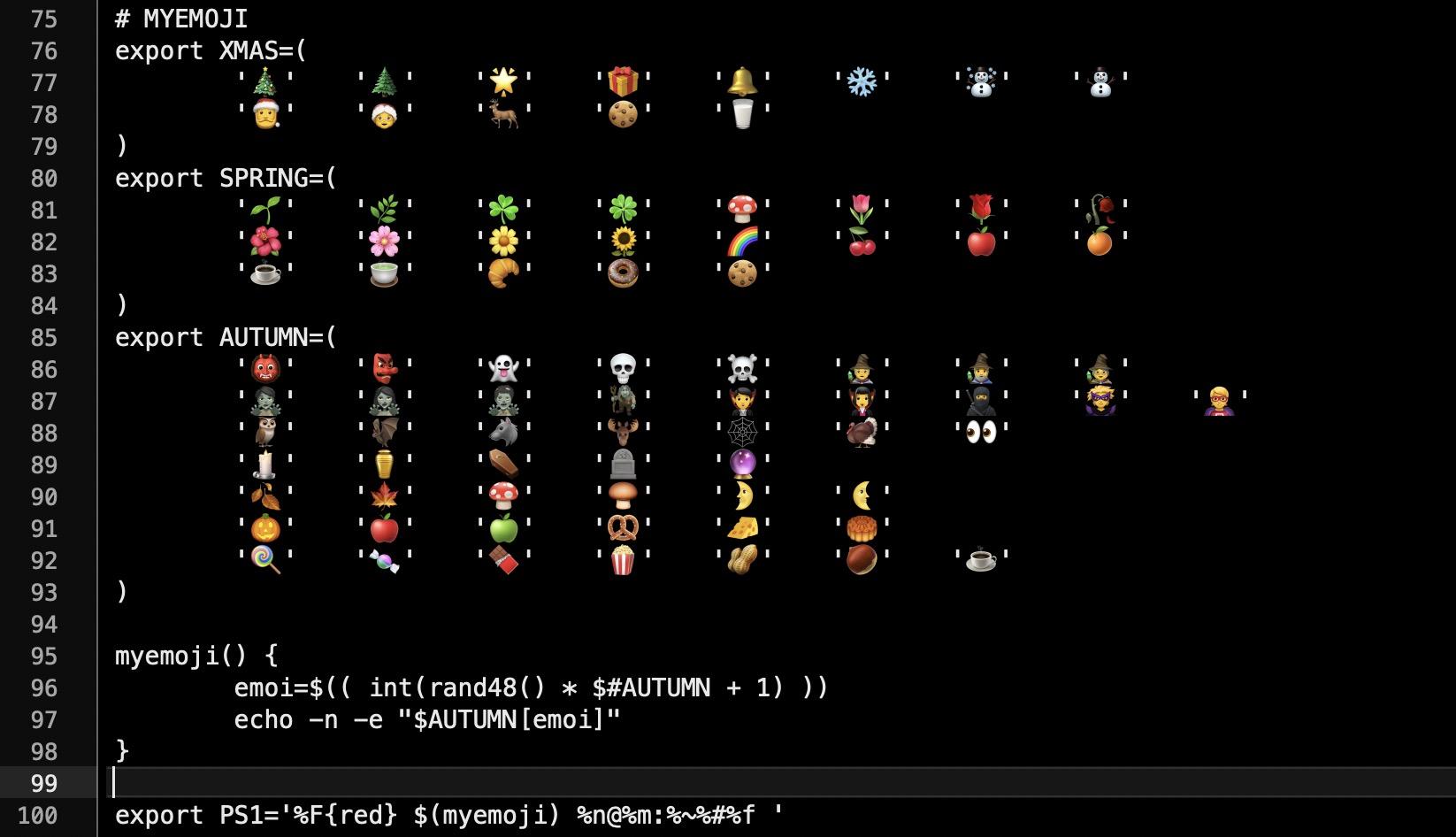
Alt...
# MYEMOJI
export XMAS=(
'🎄' '🌲' '🌟' '🎁' '🔔' '❄️' '☃️' '⛄'
'🎅' '🤶' '🦌' '🍪' '🥛'
)
export SPRING=(
'🌱' '🌿' '☘️' '🍀' '🍄' '🌷' '🌹' '🥀'
'🌺' '🌸' '🌼' '🌻' '🌈' '🍒' '🍎' '🍊'
'☕️' '🍵' '🥐' '🍩' '🍪'
)
export AUTUMN=(
'👹' '👺' '👻' '💀' '☠️' '🧙' '🧙♂️' '🧙♀️'
'🧟' '🧟♀️' '🧟♂️' '🧌' '🧛' '🧛♀️' '🥷' '🦹' '🦸'
'🦉' '🦇' '🐺' '🫎' '🕸️' '🦃' '👀'
'🕯️' '⚱️' '⚰️' '🪦' '🔮'
'🍂' '🍁' '🍄' '🍄🟫' '🌛' '🌜'
'🎃' '🍎' '🍏' '🥨' '🧀' '🥮'
'🍭' '🍬' '🍫' '🍿' '🥜' '🌰' '☕️'
)
myemoji() {
emoi=$(( int(rand48() * $#AUTUMN + 1) ))
echo -n -e "$AUTUMN[emoi]"
}
export PS1='%F{red} $(myemoji) %n@%m:%~%#%f '
Updated my seasonal prompt emoji:
#zsh #unix

Alt...
# MYEMOJI
export XMAS=(
'🎄' '🌲' '🌟' '🎁' '🔔' '❄️' '☃️' '⛄'
'🎅' '🤶' '🦌' '🍪' '🥛'
)
export SPRING=(
'🌱' '🌿' '☘️' '🍀' '🍄' '🌷' '🌹' '🥀'
'🌺' '🌸' '🌼' '🌻' '🌈' '🍒' '🍎' '🍊'
'☕️' '🍵' '🥐' '🍩' '🍪'
)
myemoji() {
emoi=$(( int(rand48() * $#SPRING + 1) ))
echo -n -e "$SPRING[emoi]"
}
export PS1='%F{red} $(myemoji) %n@%m:%~%#%f '

Some delightful notes from @thalia on recent #unix V4 adventures including using ed(1)
https://github.com/thaliaarchi/unix-v4-demo/blob/main/README.md
While hacking today, I needed to center some text, normally I do that in BBEdit but this was in shell.
Am I just missing an obvious shell command? for 40 years? Quick apropos or searching didn't turn one up..
Anyway, here's align.py.
no args or -c: Center, -l: Left, -r: Right
-w N: set width if not shell columns.
(WHICH, Python can't get w from os.environ["COLUMNS"] or stty size, had to use shutil. WEIRD.)
#unix #python
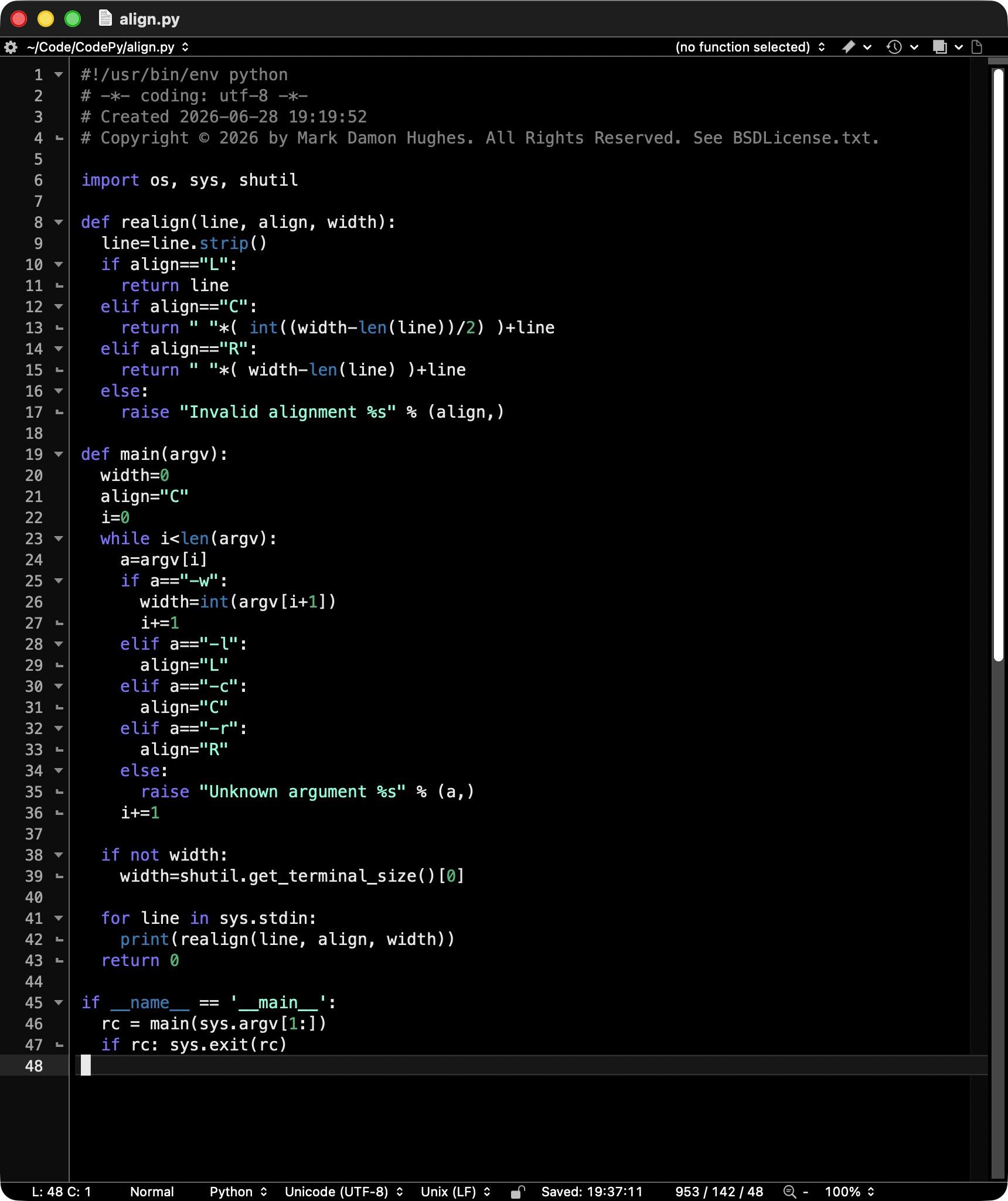
Alt...
#!/usr/bin/env python
# -*- coding: utf-8 -*-
# Created 2026-06-28 19:19:52
# Copyright © 2026 by Mark Damon Hughes. All Rights Reserved. See BSDLicense.txt.
import os, sys, shutil
def realign(line, align, width):
line=line.strip()
if align=="L":
return line
elif align=="C":
return " "*( int((width-len(line))/2) )+line
elif align=="R":
return " "*( width-len(line) )+line
else:
raise "Invalid alignment %s" % (align,)
def main(argv):
width=0
align="C"
i=0
while i<len(argv):
a=argv[i]
if a=="-w":
width=int(argv[i+1])
i+=1
elif a=="-l":
align="L"
elif a=="-c":
align="C"
elif a=="-r":
align="R"
else:
raise "Unknown argument %s" % (a,)
i+=1
if not width:
width=shutil.get_terminal_size()[0]
for line in sys.stdin:
print(realign(line, align, width))
return 0
if __name__ == '__main__':
rc = main(sys.argv[1:])
if rc: sys.exit(rc)